When you need to send something internationally, the default option is usually a courier service.
But that's no longer the only choice.
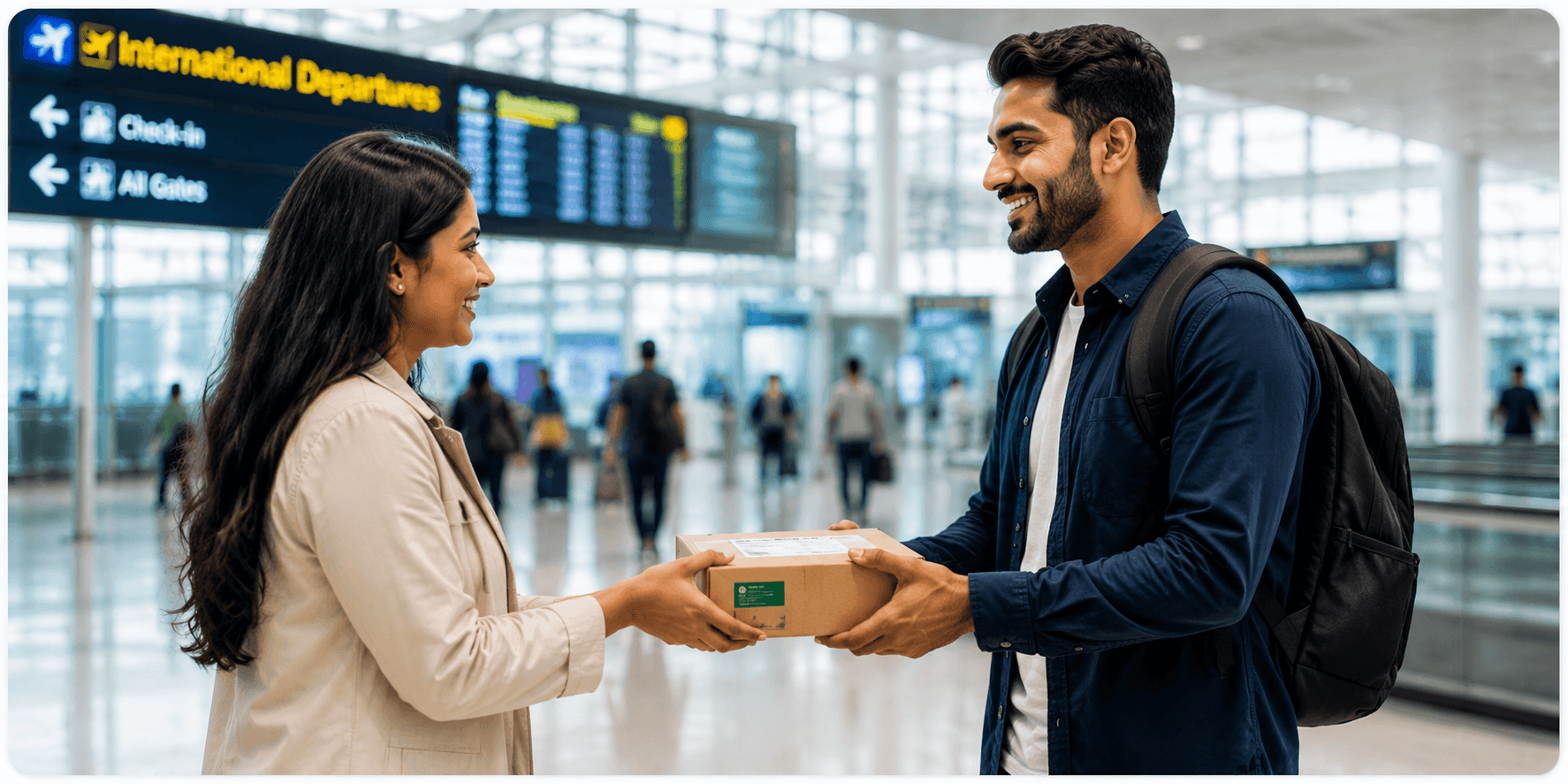
A growing number of people are now exploring traveller-powered delivery, where parcels move with verified travellers already flying to the destination.
So which option is better?
The answer depends on what you're sending and what matters most to you.
How Traditional International Couriers Work
Traditional courier companies operate through a network of collection centers, warehouses, sorting hubs, flights, customs clearance processes, and local delivery partners.
This model works well for:
- Business shipments
- Large parcels
- High-value commercial goods
- Time-sensitive corporate deliveries
The trade-off is that multiple touchpoints can increase both cost and transit time, especially for smaller personal shipments.
How Traveller-Powered Delivery Works
Traveller-powered delivery follows a simpler approach.
A traveller who is already flying to a destination carries an eligible parcel as part of their existing journey.
This is not a new behavior.
For years, families have asked relatives, friends, and colleagues travelling abroad to carry documents, medicines, books, gifts, and personal items.
Technology platforms are simply making these connections easier and more organized.
Comparing the Two
Cost
For small personal shipments, traveller-powered delivery can often be more economical because the traveller is already taking the trip.
Traditional couriers generally have fixed operational costs regardless of parcel size.
Speed
Courier deliveries may involve multiple handling stages.
Traveller-powered deliveries can sometimes move faster when a matching traveller is already flying the route.
Convenience
Couriers offer a structured process and broad global coverage.
Traveller-powered delivery depends on route availability and traveller matches.
Parcel Type
Courier services are generally better suited for large, commercial, or complex shipments.
Traveller-powered delivery works best for small, travel-friendly items.
When Should You Choose a Courier?
A traditional courier may be the better option when:
- You are shipping commercial goods
- The parcel is large or bulky
- You require extensive tracking
- The destination has limited traveller availability
When Does Traveller Delivery Make Sense?
Traveller-powered delivery may be worth considering when:
- The item is small and travel-friendly
- Cost matters
- A traveller is already flying your route
- You want a more direct movement of the parcel
Final Thoughts
Neither model is universally better.
Traditional couriers remain an excellent option for many shipments.
However, for small international deliveries, traveller-powered networks are creating a compelling alternative by leveraging journeys that are already taking place.
As global travel continues to increase, this approach may become an increasingly important part of how individuals move items across borders.